How Advanced Heat Treatment Technology is Revolutionizing Nail Manufacturing Quality
The nail manufacturing industry is undergoing a quiet revolution that most buyers never see—but definitely feel in product performance. Advanced heat treatment processes and metallurgical innovations are transforming how steel nails, construction iron nails, and specialized fasteners are produced. For B2B buyers, construction professionals, and hardware distributors, understanding these manufacturing advances explains why some suppliers consistently deliver superior products while others struggle with quality issues. Let's explore what's happening behind the factory doors.
Material Selection: Why Wire Quality Determines Final Product Performance
Not all steel wire is created equal, and this fundamental truth drives everything in nail manufacturing. Leading Chinese nail manufacturers have become increasingly selective about raw material sourcing, recognizing that wire quality directly impacts the finished product's strength, consistency, and durability.
High-carbon steel wire, the primary material for construction iron nails and heavy-duty fasteners, requires precise carbon content—typically 0.65% to 0.75%—to achieve optimal hardness without brittleness. Premium suppliers source wire from certified steel mills with rigorous quality control, ensuring consistent metallurgical properties across entire production runs. This matters enormously for collated nails used in pneumatic applications, where even slight variations can cause feeding problems or breakage.
Low-carbon steel wire serves different applications, particularly for finishing nails and headless iron nails where flexibility prevents wood splitting. Here again, wire consistency proves critical. Professional nail factories in China's manufacturing hubs test incoming wire batches for tensile strength, ductility, and dimensional accuracy before production begins.
For B2B buyers, this material selectivity translates to tangible benefits: fewer bent nails during installation, consistent performance across batches, and predictable behavior in demanding applications. When comparing nail suppliers, asking about their raw material sourcing and testing protocols reveals much about their quality commitment.
Heat Treatment Revolution: Precision Control Changes Everything
Perhaps the most significant recent advancement involves computer-controlled heat treatment processes. Traditional nail manufacturing relied on batch heating methods with limited temperature precision. Modern facilities now employ continuous heat treatment systems with real-time monitoring and adjustment.
Why does this matter? Heat treatment determines a nail's hardness, toughness, and resistance to bending or breaking. For steel nails and construction iron nails, proper heat treatment creates the ideal balance: hard enough to penetrate dense materials without bending, yet tough enough to absorb impact without shattering.
Advanced Chinese nail manufacturers have invested in automated heat treatment lines that maintain temperature tolerances within ±5°C—compared to ±20°C or worse in older systems. This precision ensures every nail in a batch receives identical treatment, eliminating the performance variations that plague lower-quality products.
The practical impact? Construction companies using premium coil nails experience virtually zero misfires or jams in pneumatic nail guns. Contractors driving collated nails into hardwoods encounter minimal bending. These aren't minor conveniences—they're productivity multipliers that justify premium pricing.
Wire Drawing Technology: The Foundation of Dimensional Accuracy
Before becoming nails, steel wire undergoes drawing processes that reduce diameter and improve surface finish. This seemingly simple step profoundly affects final product quality, yet it's where many manufacturers cut corners.
Modern multi-stage wire drawing systems employed by professional Chinese nail factories achieve remarkable dimensional consistency—critical for automated collation processes and pneumatic tool compatibility. Each drawing die is precisely sized and regularly replaced to maintain tolerances. Lubricants are carefully selected to minimize surface defects.
Compare this to older single-stage or poorly maintained drawing systems producing wire with diameter variations that cascade through manufacturing. The result? Inconsistent nail dimensions that cause feeding problems in nail guns, uneven collation, and unpredictable performance.
For buyers sourcing bulk quantities of strip-collated nails or coil nails, asking suppliers about their wire drawing capabilities reveals their manufacturing sophistication. State-of-the-art facilities proudly discuss their multi-stage systems and quality control measures. Those deflecting such questions likely operate substandard equipment.
Coating Application: Where Chemistry Meets Engineering
Galvanizing and coating technologies have evolved significantly, driven by durability demands and environmental regulations. The difference between quality galvanized steel nails and budget alternatives often comes down to coating process sophistication.
Hot-dip galvanizing, the gold standard for corrosion protection, requires precise temperature control, immersion timing, and zinc bath composition. Leading nail manufacturers in China operate modern galvanizing lines with automated process control, ensuring uniform coating thickness and excellent adhesion. The result: coil nails and construction iron nails that withstand decades of outdoor exposure without rust failure.
Electro-galvanizing offers thinner coatings suitable for indoor applications and aesthetic considerations. Here again, process control determines quality. Consistent current density, bath chemistry monitoring, and proper rinsing prevent coating defects that cause premature corrosion.
Newer coating technologies include polymer and epoxy applications providing both corrosion resistance and color options. These specialized coatings serve niche markets—colored headless iron nails for finish carpentry, or enhanced-grip coatings for high-vibration applications. Manufacturers offering these options demonstrate R&D capabilities beyond commodity production.
Point Formation: Precision Engineering at Microscopic Scale
The business end of every nail—its point—receives surprisingly sophisticated engineering attention at quality-conscious facilities. Point geometry affects penetration force, wood splitting tendency, and installation consistency. Modern Chinese nail factories employ precision grinding and cutting systems that form points to exacting specifications.
Diamond-point designs minimize splitting in hardwoods. Chisel points excel in softwoods and rapid framing applications. Blunt points serve specialized applications where controlled penetration matters. Each geometry requires specific tooling and process control to execute correctly.
Automated vision inspection systems at advanced facilities check every nail's point formation, rejecting defective units before packaging. This level of quality control, once reserved for aerospace fasteners, is now standard practice among leading nail manufacturers serving professional markets.
For construction companies and contractors, properly formed points mean faster installation, less material waste from splitting, and reduced hand fatigue during manual applications. These benefits compound across thousands of fasteners, justifying partnerships with quality-focused suppliers.
Shank Engineering: Beyond Simple Wire Cutting
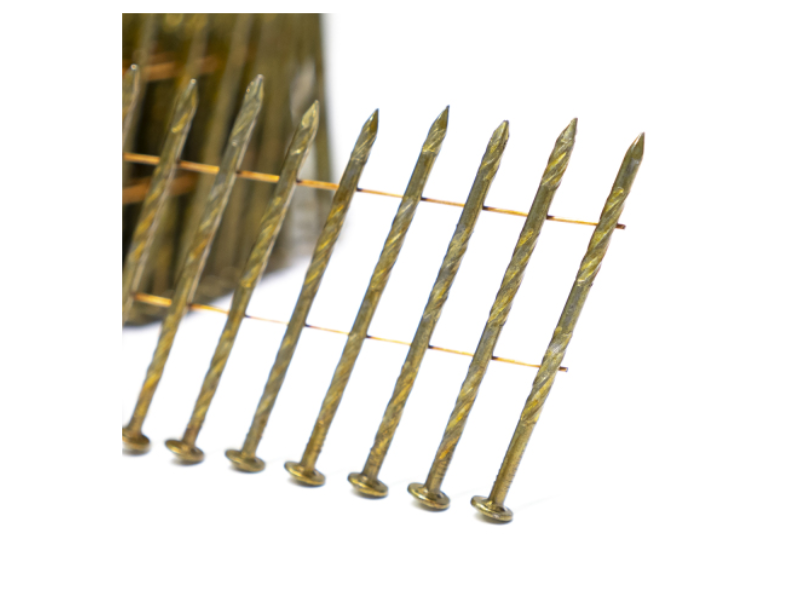
Shank design—the nail body between head and point—has evolved from simple smooth cylinders to engineered profiles optimizing holding power. Ring-shank, screw-shank, and twisted designs multiply withdrawal resistance, critical for applications experiencing pulling forces.
Manufacturing these enhanced shanks requires specialized equipment and precise process control. Thread-rolling dies for screw-shank nails must maintain tight tolerances to produce consistent thread profiles. Ring-cutting tools creating annular grooves need regular maintenance and calibration.
Progressive Chinese nail manufacturers offer comprehensive shank options across their product lines, from basic smooth construction iron nails to advanced screw-shank collated nails for structural applications. This variety demonstrates manufacturing flexibility and technical capability—hallmarks of sophisticated suppliers versus commodity producers.
Quality Control Integration: From Raw Material to Finished Product
Perhaps the most significant manufacturing advancement involves integrated quality management systems spanning the entire production process. Leading nail factories in China have implemented statistical process control, automated inspection, and comprehensive testing protocols that were rare even a decade ago.
Incoming raw material testing, in-process monitoring, heat treatment verification, coating thickness measurement, dimensional inspection, and performance testing now occur systematically at professional facilities. Data collection enables continuous improvement and immediate correction when variations appear.
For B2B buyers, suppliers offering detailed quality documentation—batch test reports, material certifications, dimensional inspection data—demonstrate this sophisticated approach. Those unable or unwilling to provide such documentation likely lack the systems generating it, suggesting quality gambles rather than assured consistency.
Strategic Implications: Manufacturing Quality Drives Market Position
The nail manufacturing sector increasingly divides into two tiers: sophisticated producers investing in advanced materials, precision processes, and quality systems versus commodity manufacturers competing primarily on price. This division creates strategic choices for buyers.
Construction companies managing critical projects, hardware distributors serving professional contractors, and industrial manufacturers requiring consistent performance increasingly partner with technology-leading Chinese nail exporters. The modest price premium—often just 15-25%—buys dramatic quality improvements, supply reliability, and technical support.
Understanding these manufacturing realities helps buyers make informed decisions. When evaluating nail suppliers, look beyond price lists to production capabilities, quality systems, and material sourcing. The fasteners holding your projects together deserve this scrutiny.
The future belongs to manufacturers embracing manufacturing excellence—and buyers who recognize its value.